Core Training After 40: 3 Movements for Strength, Mobility and Rotation
When most people think about core training, they think about crunches, sit-ups, planks, or maybe some type of leg raise.
Those exercises can absolutely have value.
But your core is responsible for a lot more than just flexing the spine forward or holding a static position.
A capable core also has to help you:
- control the pelvis
- create and resist rotation
- bend and stabilize laterally
- transfer force between the upper and lower body
- move through larger ranges without losing control
That becomes even more important after 40.
At Roundbox Fitness, one of the things I focus on as a Seattle personal trainer is helping people maintain strength and mobility without making training unnecessarily complicated.
Instead of doing one exercise for strength, another for mobility, another for stability, and another for coordination, I like movements that let us train several of those qualities together.
That’s where the Grappler becomes really useful.
For core training, we use three foundational patterns:
Front → Side → Rotation
Each one challenges the trunk in a different way, and together they give us a more complete approach to core strength.
1. Grappler Core Alternating Knee Drive
This is our front-of-the-core movement.
You start lying on your back with the Grappler held around waist height.
One knee drives firmly into the center pad while the opposite leg stays extended and hovering just above the floor.
Hold that contraction for about 2–3 seconds, then gradually switch sides.
As one knee comes up and drives into the Grappler, the opposite leg extends back out.
The goal is not to rush.
The goal is to create tension.
What It Trains
This movement challenges the:
Rectus abdominis
Deep core musculature
Hip flexors
Pelvic control
One thing I think is important here is the relationship between the core and hip flexors.
People sometimes talk about the hip flexors “taking over” core work as if hip-flexor involvement is automatically a bad thing.
But the hip flexors and abdominal wall are supposed to work together.
The real question is whether you can create force through the hips while keeping the pelvis and spine controlled.
That’s what we’re trying to teach here.
By intentionally driving the knee into the Grappler while the opposite leg remains suspended, we can create a very strong contraction without having to pile on external weight or perform endless repetitions.
For many people, that makes the movement easier to scale and easier to keep comfortable on the lower back.
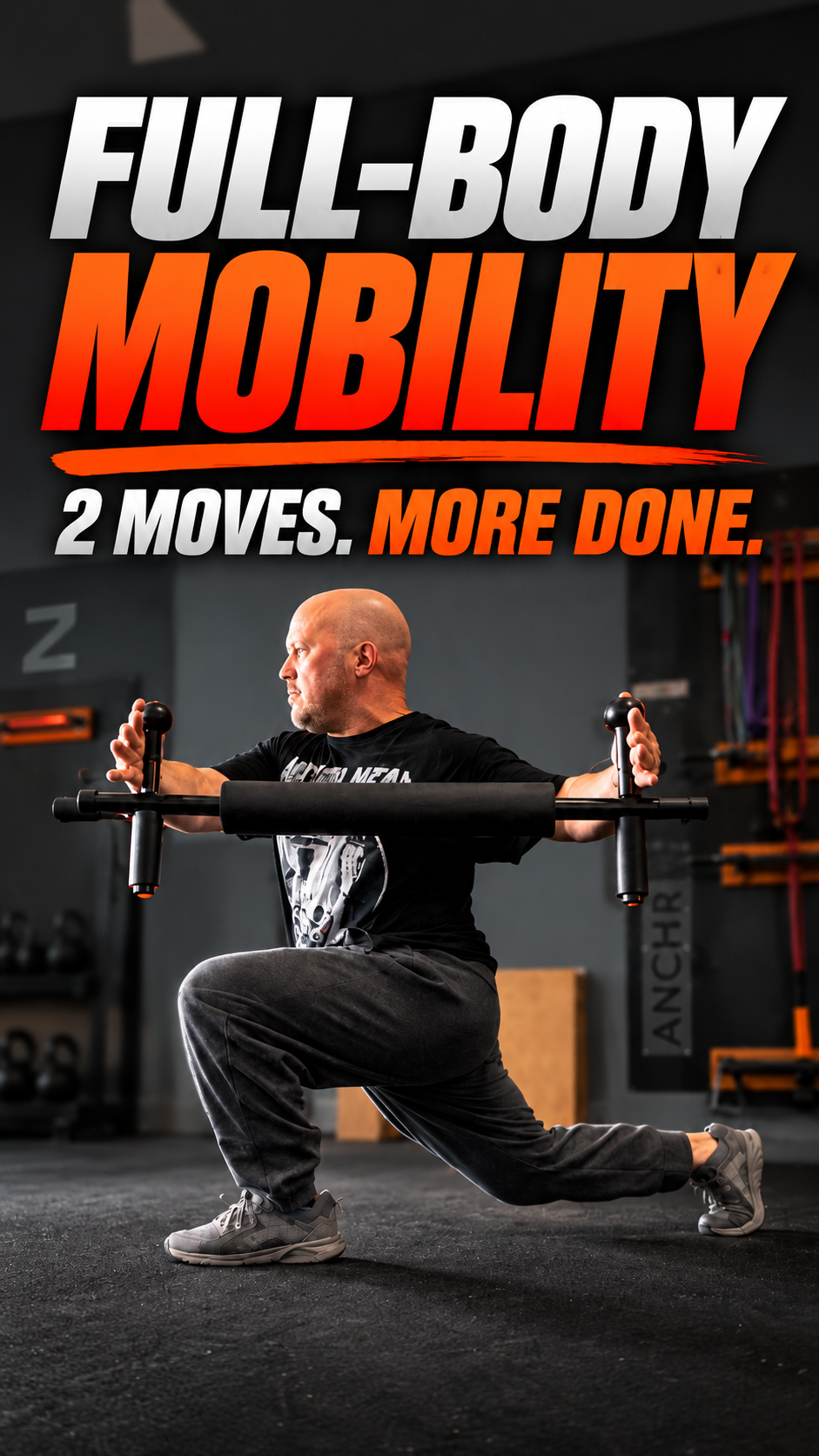
2. Grappler Lateral Flexion
The second movement takes us to the side of the core.
Start in a split stance while holding the Grappler handles and pulling apart to create tension.
From there, laterally flex the spine toward the front leg as far as you can comfortably control.
Then slowly extend the arms outward and pause at the end range.
Return with control.
What It Trains
The main areas involved are:
Internal and external obliques
Spinal erectors
Lats
Lateral trunk musculature
A lot of people train their core almost entirely from the front.
But the trunk also has to control side bending.
Your internal and external obliques work together on the same side to help create lateral flexion, while the erectors and other trunk muscles help control the movement.
The lats also get taken through a long range under tension as the arms extend.
That makes this more than just a side bend.
You’re combining:
strength
mobility
end-range control
muscular tension
And rather than simply stretching the side of the body, we’re asking the muscles to become stronger through that range.
For people over 40, I like that idea a lot.
The goal isn’t simply to preserve range of motion.
The goal is to own that range.
3. Grappler Kneeling Core Rotation
The third movement gives us the rotational component.
Start in a half-kneeling position with one knee up.
Hold the Grappler slightly below shoulder height and squeeze inward on the handles to create tension.
Keep the hips and belly button facing forward while your eyes follow the Grappler.
Rotate through the thoracic spine as far as you can over the forward knee.
Pause at the end range.
Then rotate in the opposite direction as far as you can control and pause again.
What It Trains
The main focus is on the:
Internal and external obliques
Abdominals
Thoracic musculature
Upper back
This is where the obliques become especially interesting.
During rotation, the external oblique on one side works together with the internal oblique on the opposite side.
For example, when you rotate to the right, the left external oblique and right internal oblique contribute strongly to that movement.
At the same time, the trunk has to control the pelvis so the hips don’t simply spin along with the upper body.
That gives us both rotation and anti-rotation in the same drill.
The upper body is moving.
The pelvis is being controlled.
And the obliques are helping connect the two.
That kind of coordination becomes important in everyday movement and even more important in athletics.
Walking, swinging, throwing, golfing, martial arts, racquet sports, and simply turning to reach for something all require the body to transfer force through rotation.
Why Train the Core in Multiple Directions?
This is the bigger point.
Your core is not just an abdominal muscle.
It’s a system designed to manage force around the trunk.
That means being able to:
produce movement
control movement
resist movement
And it has to do those things in more than one direction.
Traditional exercises like planks, crunches, and sit-ups can be useful, but they don’t cover every function of the trunk.
That’s why we like to think about core training as:
Front → Side → Rotation
The Alternating Knee Drive develops the front of the trunk and its relationship with the hips.
The Lateral Flexion develops strength and control through the side of the trunk.
The Kneeling Rotation trains the obliques and upper body to create and control rotation while the pelvis stays organized.
Together, those three patterns give us a more complete picture of what core training can look like.
Core Training Without Endless Reps
Another challenge I often see with traditional floor-based core training is progression.
At first, basic exercises work well.
But eventually, people often end up doing:
more reps
longer holds
more complicated variations
or adding external weight
That can work, but it’s not the only option.
With the Grappler, we can create tension through intent.
Push harder.
Pull harder.
Squeeze harder.
Increase the range.
Pause longer.
Move more slowly.
That gives us several ways to make a movement more challenging without immediately adding more load.
For people who want effective core work while keeping the spine comfortable, that can be extremely useful.
What About Back Pain?
When someone has a history of back irritation, I’m not interested in forcing them through a movement simply because an exercise is supposed to be “good for the core.”
We look for:
pain-free range
pain-free speed
pain-free levels of tension
Then we gradually build capacity from there.
That doesn’t mean avoiding movement.
In many cases, the goal is exactly the opposite.
We want to expose the body to rotation, lateral flexion, hip movement, and trunk tension in ways the person can tolerate and control.
Over time, that gives us an opportunity to make those positions feel stronger and more familiar instead of treating them as something fragile.
Why This Matters After 40
After 40, a lot of people notice that strength isn’t necessarily the only thing they’re losing.
They may still be able to lift reasonably heavy weights, but they feel:
stiffer
less rotational
less coordinated
less comfortable moving through larger ranges
That’s why I don’t want core training to become another isolated body-part routine.
I want it to contribute to how the entire body moves.
A strong core should help you feel more capable when you:
turn
reach
bend
walk
run
play sports
lift
and move through everyday life
And for athletes, the same principles apply at a higher level.
Athletic movement requires the body to transfer force across the trunk while the hips and shoulders move in different directions.
The core is the bridge between those regions.
If that bridge can create, absorb, and control force effectively, the whole body tends to move better.
A Simple 3-Movement Grappler Core Session
You don’t need a huge number of exercises.
A simple foundational session can look like:
1. Grappler Core Alternating Knee Drive
2–3 second contraction per side
Controlled alternating reps
2. Grappler Lateral Flexion
Slow, controlled range
Pause at the end position
3. Grappler Kneeling Core Rotation
Rotate through the thoracic spine
Pause at each end range
Start with 1–2 sets of each movement.
Stay within a pain-free range.
Then gradually increase the amount of tension, range of motion, time under tension, or number of sets as your control improves.
The goal is not to destroy your abs.
The goal is to build a core that can produce and control movement in multiple directions.
Train With Us in Seattle
If you’re in Seattle and want to build strength, mobility, joint health and core control with a training program designed around your individual needs, explore personal training at Roundbox Fitness.
Get Started With Roundbox Fitness Today!
Train With Roundbox Anywhere
If you’re outside Seattle and want to explore the movements, methods and equipment behind our training system, explore Roundbox training tools and programs.
Roundbox Fitness Mantis Stix Grappler – Roundbox Fitness Equipment