Conditioning After 40: A Full-Body Alternative to Traditional Cardio
When people think about conditioning, they usually think about running, biking, rowing, or spending time on a piece of cardio equipment.
Those are all great options.
But they aren’t the only way to challenge your heart and lungs.
As a Seattle personal trainer, one of the things I’m always looking for is how to help people get more out of the time they have to train. Especially after 40, we’re usually trying to maintain several physical qualities at once.
We want conditioning.
We want strength.
We want mobility.
We want coordination and joint control.
And most people don’t have unlimited time to train each of those qualities separately.
That’s one of the reasons we use elastic recoil training at Roundbox Fitness.
Rather than relying only on traditional cardio, we can use rhythmic, full-body movements that raise the heart rate while also asking the shoulders, back, core, hips, and legs to work together.
What Is Elastic Recoil?
Think about loading and releasing a spring.
Your muscles and tendons can absorb force, store some of that energy, and then help return it as the movement changes direction.
That’s the basic idea behind elastic recoil.
With the WaveBreakers, we use large rhythmic movements that repeatedly ask the body to:
accelerate → absorb force → change direction → accelerate again
The arms may swing through large arcs. The trunk rotates or bends laterally. The hips and legs contribute to the movement.
Each time the direction changes, the body has to control the force first, then redirect it.
That repeated cycle helps train the body to become better at producing, absorbing, and transferring force while staying coordinated through large ranges of motion.
It’s one of the reasons this style of training can feel so different from slow, linear strength work.
You’re not just creating tension.
You’re creating tension while the body is moving, reacting, and changing direction.
Conditioning That Uses More of the Body
One of the things I like about this style of conditioning is that the work isn’t concentrated almost entirely in the legs.
Running and cycling are excellent conditioning methods, but most of the muscular work is being performed by the lower body.
With WaveBreaker training, we can choose movements that involve the:
Shoulders and arms
Lats and upper back
Core and rotational muscles
Hips and legs
That means we’re creating cardiovascular demand while moving the muscular work around the body.
Instead of having one region carry most of the workload, we can build conditioning through larger, more integrated full-body patterns.
Whole-Body Glucose Demand
Another benefit of full-body conditioning is that more muscle mass is actively participating in the work.
Running and cycling place most of the muscular demand on the lower body. With WaveBreaker training, the legs, hips, core, back, shoulders, and arms can all be contributing at the same time.
Working muscle uses glucose for fuel, so when more regions of the body are actively involved, that glucose demand is spread across more muscle groups.
In simple terms, instead of asking mainly the legs to do the metabolic work, we’re creating demand throughout the body.
That’s one of the reasons I like full-body conditioning so much: you’re training the cardiovascular system while also asking a broader range of muscles to actively participate.
Mobility While You Condition
Another thing that separates this work from a lot of traditional conditioning is the size and variety of the movements.
We use:
- large upper-body arcs
- rotation
- lateral movement
- deep lower-body patterns
- changes of direction
So while your heart rate is coming up, you’re also repeatedly moving through ranges you might not use much during a run or bike ride.
That matters to me because I don’t want conditioning to become something that only challenges your cardiovascular system.
I want the movement itself to give us something too.
Better range.
Better coordination.
Better control.
Better ability to produce and absorb force.
That makes the conditioning session feel more like movement training rather than simply accumulating minutes of cardio.
It also fits into the larger approach we use in our Seattle personal training studio: whenever possible, choose training methods that develop multiple useful qualities at the same time.
The Roundbox 3-Pattern Format
Our foundational WaveBreaker conditioning format is deliberately simple.
We choose three patterns:
1 upper-body movement
1 core movement
1 lower-body movement
Each movement is performed for about 45 seconds.
We move directly from one pattern into the next:
Upper body → Core → Lower body
That gives us 2 minutes and 15 seconds of continuous work before taking a rest.
Then we recover and repeat for additional rounds.
Forty-five seconds works well because it’s long enough to create a meaningful conditioning challenge, but still short enough that most people can maintain good rhythm, range of motion, and movement quality.
From there, we can progress the session in several ways.
We can increase the speed.
Increase the range.
Produce more force into the change of direction.
Reduce the rest.
Add additional rounds.
Or increase the length of the interval.
Longer intervals — 60, 90, or even 120 seconds — can also be useful. As the intervals become longer, the emphasis naturally shifts more toward muscular and cardiovascular endurance.
That gives us a lot of ways to manipulate the workout without needing dozens of different exercises.
Three Movements, One Full-Body Session
For this foundational session, the three movements we’re using are:
WaveBreaker Runners
This is our upper-body pattern.
Large arm and shoulder swings create a rhythmic pulling action through the lats and upper back while the trunk and hips work to keep the body organized.
The arms are moving aggressively, but the core and lower body still have a job to do.
That combination lets us work the upper body through a large athletic range while maintaining full-body control.
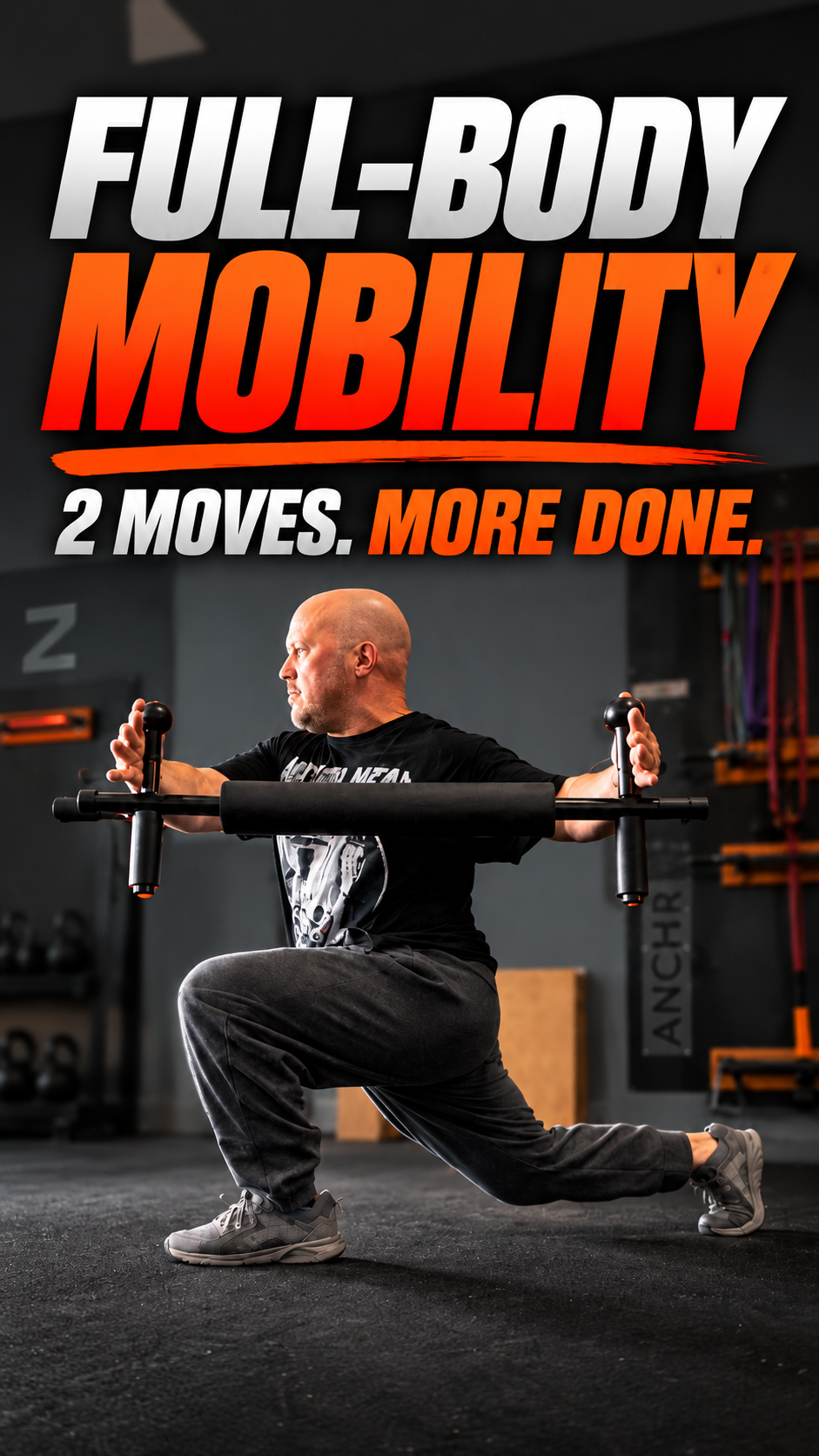
WaveBreaker Horizontal Rotations
This is our core and rotational pattern.
The WaveBreakers travel across the body through a large horizontal arc.
The abdominals and obliques help create and control the rotation while the upper back contributes to accelerating and decelerating the movement.
Every time the WaveBreakers change direction, the body has to control the force before sending it back the other way.
So this isn’t simply about twisting farther.
It’s about producing rotational force, controlling it, and redirecting it.
WaveBreaker Throwdowns
This is our lower-body/full-body pattern.
The arms begin overhead and accelerate downward as the body drops into a squat.
The lats and core help drive the WaveBreakers down while the glutes and quads contribute through the lower body.
The arms finish behind the body before the movement reverses and starts again.
That gives us another opportunity to combine force production, deceleration, lower-body strength, and conditioning in one rhythmic pattern.
Put all three movements together and you have an upper-body, rotational, and lower-body conditioning circuit without ever getting on a treadmill or stationary bike.
Why I Like This After 40
After 40, I’m not interested in simply finding ways to make people tired.
Conditioning still matters.
But if we can elevate the heart rate while also maintaining mobility, challenging coordination, training muscular endurance, and keeping the whole body involved, that gives us a much better return on the time invested.
That’s especially important for many of the people we work with at Roundbox Fitness in Seattle.
They have careers.
They have families.
They have responsibilities.
They still want to feel strong, mobile, athletic, and capable — but training has to fit into real life.
That doesn’t mean you should stop running or biking if you enjoy them.
Those are excellent forms of exercise.
This is simply another option.
And for people who don’t enjoy traditional cardio — or who want their conditioning work to accomplish more than one thing — full-body elastic recoil training gives us another very useful tool.
Stay strong and mobile without dozens of exercises or hours in the gym.
That’s the larger idea behind the way we train at Roundbox.
Train With Us in Seattle
If you're in Seattle and want to build strength, mobility, joint health and conditioning with a training program designed around your individual needs, explore personal training at Roundbox Fitness.
Get Started With Roundbox Fitness Today!
Train With Roundbox Anywhere
If you're outside Seattle and want to explore the movements, methods and equipment behind our training system, explore Roundbox training tools and programs.
Roundbox Fitness Mantis Stix Grappler – Roundbox Fitness Equipment